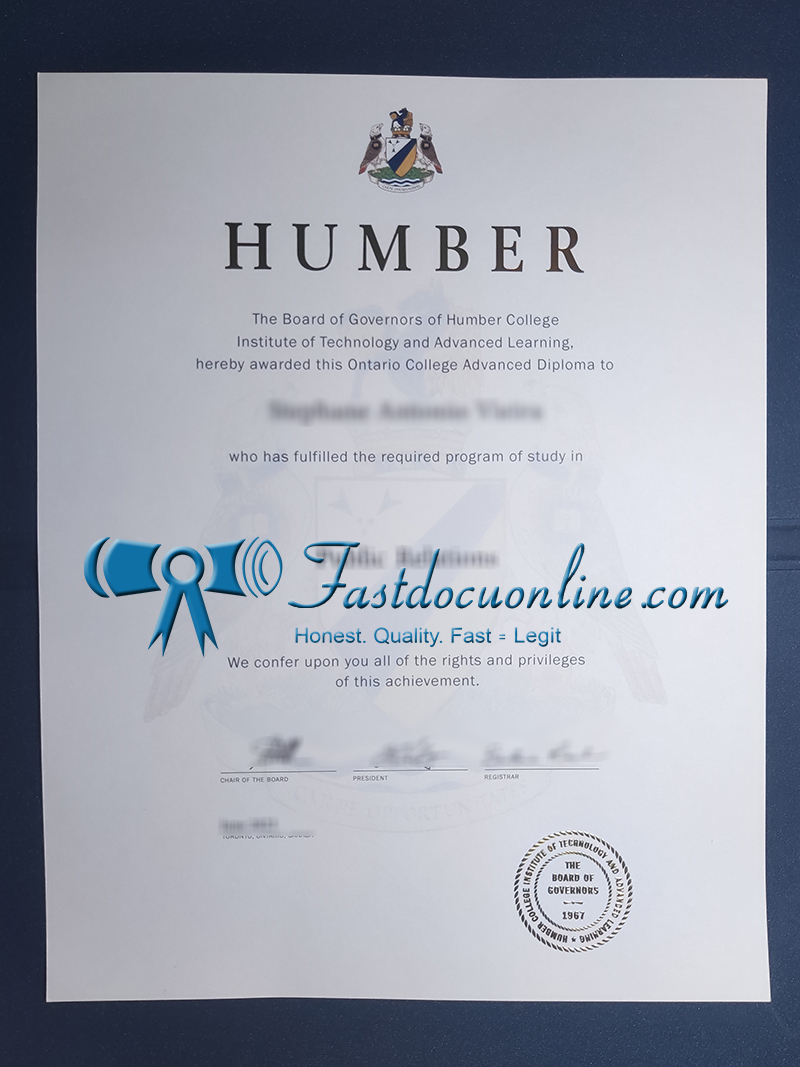
Humber College diploma
Humber College began in 1967 with a clear purpose: to give Ontario’s growing workforce the practical skills that employers actually needed. #Copy Humber College diploma.More than five decades later, that founding mission still shapes almost everything the college does. What started in a former elementary school building in Etobicoke has grown into one of Canada’s largest and most comprehensive polytechnic institutions, serving tens of thousands of students across three campuses.How to obtain Brock University diploma in Canada.
From Local Experiment to National Leader
When Humber first opened its doors, Ontario’s college system was still a bold experiment. The province had just established Colleges of Applied Arts and Technology to respond to a shortage of skilled workers, and Humber was among the first to take up that challenge. Early years were modest: the Lakeshore campus occupied a surplus school building, and the North campus began with a single field house in 1968. Over time, however, the college expanded steadily. It added the arboretum in 1977, restored historic cottages at Lakeshore, and opened major facilities such as the Learning Resource Commons in 2015 and the Barrett Centre for Technology Innovation in 2018. In 2003, the Ontario government designated Humber as an Institute of Technology and Advanced Learning, a status that allowed it to offer four-year bachelor’s degrees alongside its traditional diplomas and certificates.
Programs Built Around Real Work
Today Humber offers more than 200 full-time programs across eight academic schools, covering everything from business and health sciences to media, skilled trades, and social services. The range of credentials is deliberately broad. Students can earn one-year certificates, two- and three-year diplomas, advanced diplomas, bachelor’s degrees, and graduate certificates. This layered structure lets learners enter at different points and build toward further study if they choose. A practical nursing diploma, for instance, can lead to a degree pathway in nursing; a business administration advanced diploma can open doors to a commerce degree.
What ties these programs together is an emphasis on applied learning. Humber’s faculty bring industry experience into the classroom, and many programs include work placements, co-op terms, or hands-on labs. The college operates a full-service restaurant, a golf lab, and advanced simulation facilities for health sciences students. In mechatronics, Humber students have won back-to-back gold medals at the Skills Canada National Competition, a reflection of how seriously the college takes technical training. The Barrett Centre for Technology Innovation gives students and industry partners space to work on real problems in automation, cybersecurity, and sustainable building.
How the Credentials Are Regarded
A Humber credential carries weight for two main reasons. First, the college is publicly funded and provincially regulated, which means its programs meet standards set by the Ontario government and are recognized by employers across Canada. Second, and perhaps more importantly, Humber has built a reputation with industry. The college reports that 86 percent of graduates find employment within six months of completing their studies. That figure reflects something practical: employers know that Humber graduates have already spent time doing the work, not just reading about it.
The degree programs deserve particular mention. Humber’s bachelor’s degrees in nursing, computer science, interior design, and commerce are fully accredited and allow graduates to pursue further study or professional certification. The joint programs with the University of Guelph-Humber, where students earn both a university honours degree and a college diploma in four years, have become a model for bridging the theoretical and the applied. For students who want a graduate certificate after a university degree, Humber offers focused, one-year programs in areas like cybersecurity, supply chain management, and user experience design—credentials that signal specific, job-ready skills to hiring managers.
A College That Still Feels Like a College
Despite its growth, Humber has tried to hold onto something from its early days: a concern for students as individuals. Former president Gordon Wragg once said he wanted Humber to be the kind of institution that cared about its students, where people did not get “the run-around”. That sentiment still appears in the college’s emphasis on peer tutoring, accessible faculty, and student support services. It is also visible in the diversity of the student body, which includes thousands of international students from more than 130 countries.
In the end, Humber’s story is one of steady adaptation. It began as a response to a labor shortage and became a comprehensive polytechnic without losing sight of its original purpose: helping people learn skills that matter. For students who want a credential that employers respect, and an education that feels connected to the world beyond the classroom, Humber remains a strong choice.