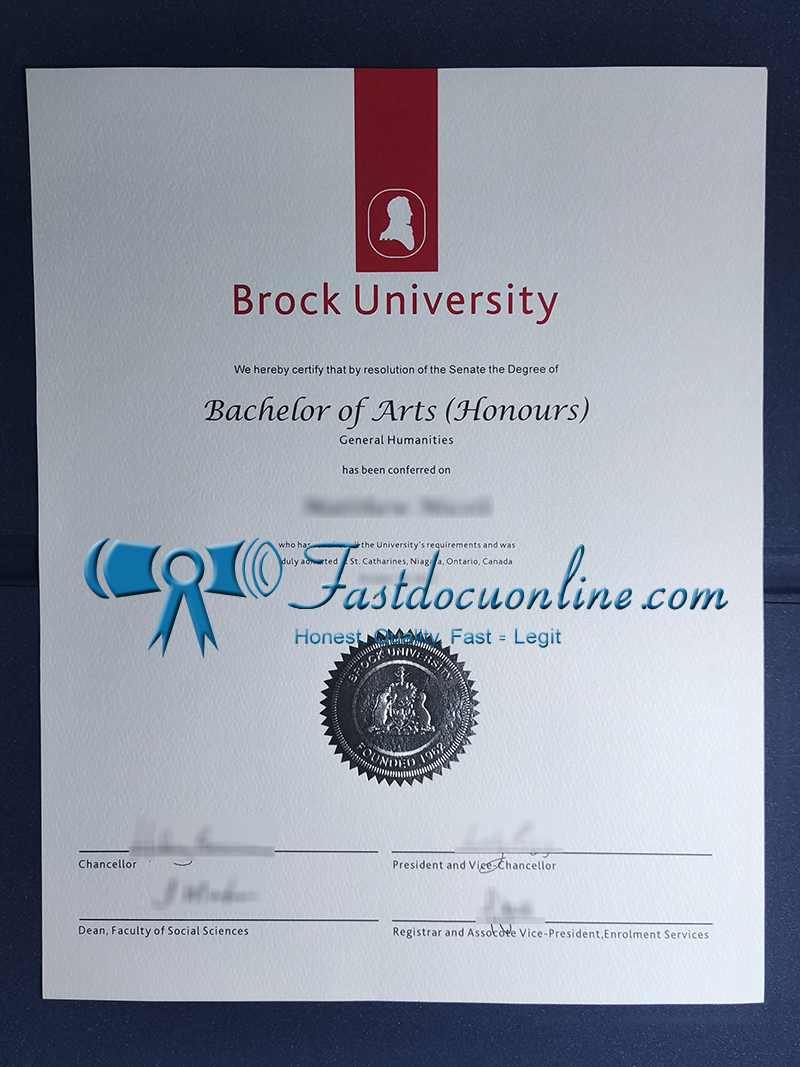
Brock University diploma
Brock University stands as one of Canada’s leading comprehensive institutions, located in the historic Niagara region of Ontario. Named after Major-General Sir Isaac Brock, a hero of the War of 1812, the university has grown from humble beginnings into a vibrant academic community that serves over 19,000 students from more than 100 countries.
Historical Background
The story of Brock University began in the late 1950s,#Copy Brock University diploma. when residents of the Niagara Peninsula recognized the need for local access to higher education. In November 1957, the Allanburg Women’s Institute formally petitioned the Ontario government to establish a university in the region. This grassroots movement gained momentum, and by 1962, the Brock Founders Committee had incorporated and received approval to create a new university.Need a Southern Alberta Institute of Technology degree replacement option?
Brock officially opened its doors in September 1964 with just 127 students attending classes in a refurbished refrigeration factory at the foot of the Niagara Escarpment. Two years later, the iconic Schmon Tower was completed, and the university began its move to its permanent home atop the escarpment. Over the following decades, Brock evolved from a small undergraduate institution into a comprehensive university with flourishing research, graduate, and doctoral programs.
Academic Programs and Faculties
Today, Brock offers more than 130 programs across seven diverse Faculties: Applied Health Sciences, Education, Humanities, Mathematics and Science, Social Sciences, Graduate Studies, and the Goodman School of Business. The university provides over 70 undergraduate programs and 50 graduate programs, including doctoral degrees.
Several programs have earned particular recognition. The Goodman School of Business ranks among Canada’s top 20 business schools. Meanwhile, Brock’s sport science programs have achieved placement among the top 100 worldwide and the top 10 in Canada. Other notable offerings include Child and Youth Studies, Oenology and Viticulture, and Digital Humanities.
Campus and Student Experience
Brock’s main campus sits atop the Niagara Escarpment, a UNESCO Biosphere Reserve, offering students breathtaking views of the surrounding region. The university operates eight residences with nearly 2,800 beds, accommodating a significant portion of its student population.
The university has invested more than a quarter-billion dollars into modern teaching and research facilities over the past decade. These include the Cairns Family Health and Biosciences Research Complex and the Marilyn I. Walker School of Fine and Performing Arts, located in downtown St. Catharines.
Brock prides itself on a student-centered approach. The university has ranked first in Canada for mental health services and consistently earns high marks for student satisfaction. With more than 600 faculty members, including 14 3M Teaching Fellowship winners and 12 Canada Research Chairs, students receive instruction from dedicated educators and researchers.
Experiential Learning and Outcomes
A defining feature of a Brock education is its emphasis on experiential learning. The university operates one of Ontario’s largest and most successful co-op programs, with more than 40 co-op options available. Through these opportunities, students gain practical work experience that complements their academic studies.
This focus on real-world preparation yields impressive results. Brock graduates enjoy a 96 percent employment rate, reflecting the university’s commitment to career readiness. The institution’s alumni network exceeds 100,000 individuals who have gone on to become leaders, innovators, and changemakers in Canada and around the world.
Community Engagement
Brock’s identity is deeply intertwined with the Niagara community that fought for its creation. As President Lesley Rigg has noted, “Brock is not just in this community – it is of this community”. This founding principle continues to guide the university’s mission today.
The university serves as a cultural, academic, and recreational hub for the region. Thousands of Niagara residents have learned to swim in Brock’s pools, exercised in its athletics facilities, and cheered on the Badgers at sporting events. Through community partnerships, volunteer initiatives, and public programming, Brock remains committed to strengthening the vitality of the region that brought it into existence.
In summary, Brock University represents a unique blend of academic excellence, community spirit, and practical education. From its origins as a community-driven initiative to its current status as a comprehensive university, Brock continues to fulfill its founding promise: providing quality education that serves both its students and the broader community.