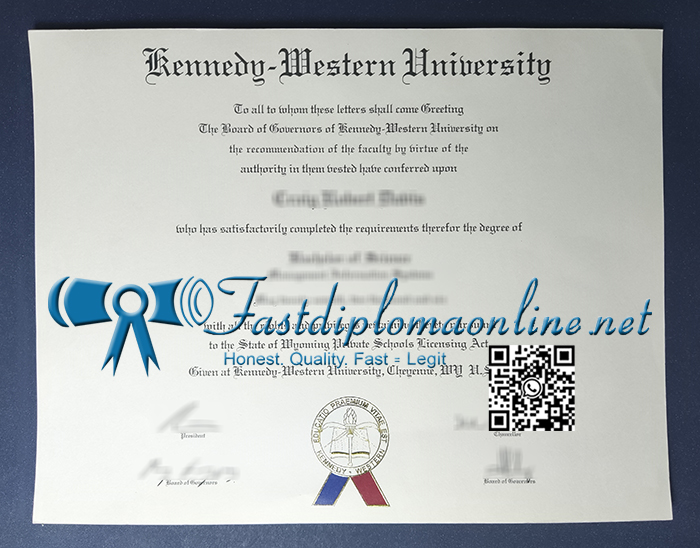
Kennedy-Western University diploma.Kennedy-Western University degree
For working adults who wanted to earn a degree on their own schedule, Kennedy-Western University once stood as a familiar name in distance education. Founded in 1984, this private institution offered undergraduate and graduate programs to busy professionals across the United States . Although the university closed its doors in 2009, its story remains relevant for anyone exploring online education options. The school’s approach to learning, its target audience, and the controversies it faced all offer valuable lessons for today’s students.John F. Kennedy University Degree Copy | Job Interview Proof.
An Education Built for Working Professionals
Kennedy-Western University catered specifically to mid-career adults who needed flexibility. The school understood that traditional campus programs often did not fit the lives of people with full-time jobs and families. Therefore, it designed a self-paced, distance-learning model. Students could access course materials online or through the mail, and they could complete their work without commuting to a physical campus . This model proved quite popular. From its founding in 1984 until 2005, the university reportedly served around 30,000 students . Many of these students were older than the average college attendee, with one report noting an average age of 42 in 2004 . They often had years of work experience in their fields, making them motivated and goal-oriented learners.
The Core of the Kennedy-Western Approach
The university’s academic model differed significantly from traditional education. At its heart, Kennedy-Western University emphasized what students already knew. The school offered credit for life and work experience, allowing students to reduce the number of courses they needed to take . This was a major selling point for working adults who felt their professional knowledge deserved recognition. When a student applied, the school would evaluate their resume and background to determine how much credit they could receive . This process often resulted in a substantial portion of degree requirements being waived. The school offered various programs, including bachelor’s and master’s degrees in areas like Business Administration, Computer Science, and Health Administration .
Life Experience Credit: A Controversial Practice
The policy of granting credit for life experience became one of the most debated aspects of Kennedy-Western University. While the idea of recognizing prior learning appealed to many students, critics questioned the rigor of the process . For instance, an investigator from the U.S. Government Accountability Office (GAO) enrolled in the school and received 43 percent credit toward a master’s degree in environmental engineering . This credit was granted without the school verifying any of the investigator’s claimed work experience . Furthermore, a survey of accredited universities found that very few offered such generous credit for life experience at the master’s level . This practice drew significant scrutiny and fueled accusations that the university was a “diploma mill” .
Why Accreditation and Awareness Matter
Kennedy-Western University (later renamed Warren National University) was never accredited by a recognized U.S. accrediting agency . This is the most critical fact for anyone considering an institution. Accreditation is a quality assurance process that ensures a school meets specific academic standards. Without it, credits may not transfer to other universities, and employers or licensing boards may not recognize the degree. The school’s attempt to gain regional accreditation ultimately failed, which led to its closure in 2009 . For students, this means the story of Kennedy-Western University serves as a powerful cautionary tale. It highlights the absolute necessity of verifying a school’s accreditation before enrolling.
In conclusion, while Kennedy-Western University offered an early and popular model for distance learning aimed at working adults, its lack of accreditation and controversial practices ultimately defined its legacy. The story reminds us that when choosing an online program, the value of a degree depends heavily on the recognized accreditation of the institution that grants it.